
Where to Stay in Pai: Best Areas and Hotels
The right area to stay in Pai comes down to one trade-off: how close you want to be to Walking Street versus how much quiet and scenery you want around you. Stay in the town center if you want to walk everywhere and skip renting a scooter. Stay along the riverside for a quieter base that is still a short walk from the night market, or head into the rice-paddy countryside or the Pai Canyon area if you are renting wheels and want mountain views over nightlife. Here is how the four main areas compare, with honest pricing guidance and the transport logistics that actually determine which one is right for your trip.
Where Should You Stay in Pai?
Most travelers do best choosing between two tiers of stay: walkable (Pai Town Center or the Riverside strip just outside it) or scenic-but-scooter-dependent (the rice-paddy countryside or the Pai Canyon area south of town). First-timers and anyone without their own transport should stick to the town center or riverside. Couples, longer-stay travelers, and anyone chasing rice-field or mountain views should budget for a scooter, taxi, or a hotel shuttle.
| Area | Vibe | Best For | Price Range (USD/night) | Need a Scooter? |
|---|---|---|---|---|
| Pai Town Center / Walking Street | Compact, lively, walkable | First-timers, backpackers, no-scooter travelers | $15 – $65 | No |
| Riverside (Pai River) | Leafy, quieter, 5–15 min walk to town | Couples wanting quiet but close | $65 – $150 | Helpful at night |
| Rice-Paddy / Countryside (North Pai, Mae Yen) | Rural, mountain and rice-field views | Couples, longer stays, digital nomads | $70 – $150 | Yes |
| Pai Canyon Area (~8km south) | Family resorts near the canyon and hot springs | Families and road-trippers with a scooter or car | $40 – $120 | Yes |
Pai Town Center and Walking Street: Best for First-Timers
The town center is the compact core around Walking Street, where the night market, bars, restaurants, and tour and bus offices all sit within a few blocks of each other. It is the only genuinely car-free option in Pai, which makes it the easiest base if you do not want to rent a scooter. The trade-off is noise: the market street gets loud with music and crowds in high season, especially on weekends. Budget guesthouses, hostels, and a handful of boutique hotels fill this area, and it suits backpackers, solo travelers, and anyone who prioritizes convenience over quiet.
Riverside: A Quieter Base Still Close to Everything
The riverside strip along the Pai River, roughly a 5 to 15 minute walk from the town center, trades a bit of distance for a lot of quiet. Restaurants like Nigiri House and Om Garden Cafe sit nearby, and several resorts here lean into river activities such as tubing, kayaking, and paddleboarding. It is walkable in daylight, but late-night returns are easier with a scooter or a pre-arranged ride, since Pai has no metered taxis and only on-demand songthaews with no fixed schedule. This area suits couples and travelers who want a quieter-but-still-close base without fully committing to the countryside.
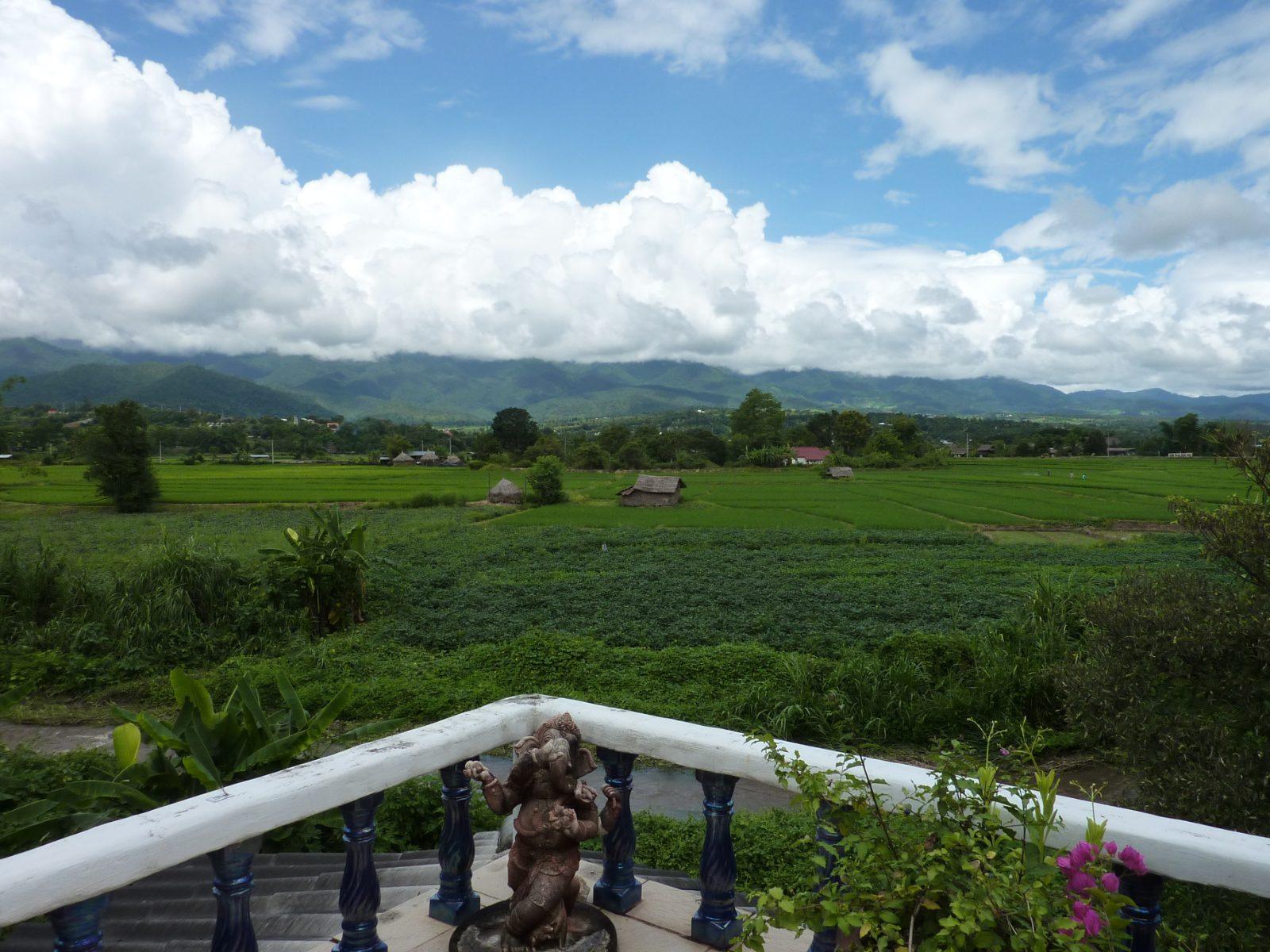

Rice fields outside Pai: Flora-Victoria / CC0 · Pai Canyon: Sgroey / CC BY-SA 4.0
Rice-Paddy Countryside: Best for Views and Seclusion
The rural zone outside town, sometimes called North Pai or Mae Yen depending on the source, is where Pai’s postcard mountain and rice-field views live. Larger resorts, private villas, and bungalow compounds are concentrated here, near attractions like the Sai Ngam hot springs and Santichon Village. There is not much nightlife nearby, and a scooter, taxi, or hotel shuttle is effectively required to reach the town center — night driving on the unlit roads outside town is best avoided, so plan on a shuttle or a ride if you are staying out here without your own transport confidence.
Pai Canyon Area: Best for Families and Road-Trippers
About 8 km south of town via Highway 1095, a separate pocket of resorts clusters near Pai Canyon, the Land Split, Pam Bok Waterfall, the Boon Ko Ku So bamboo bridge, and Tha Pai Hot Springs. Properties here often run free shuttles into downtown, which offsets the distance. This area suits families and travelers with a rental scooter or car who would rather have easy access to the canyon and hot springs than to nightlife.
What Hotels Should You Actually Book in Pai?
Named-property pricing in Pai changes with the season and is reported inconsistently across sources, so treat every figure below as a starting point to confirm at booking time, not a guarantee.
| Tier | Example Properties | What You Get | Reported From (USD/night) |
|---|---|---|---|
| Budget | RimPai Cottage, Atlas Central, Pai Country Hut | Riverside bungalows or bamboo chalets, dorms to simple privates | $15 – $65 |
| Mid-Range | Pai Village Boutique Resort, Pairadise Hotel | Bungalow-style rooms, pools, breakfast included | $110 – $150 |
| Upscale | Reverie Siam, The Oia Pai Resort, Bura Lumpai Resort | Themed resorts, free town shuttles, two pools at some properties | $150 – $200+ |
Reverie Siam and Pai Village Boutique Resort are the two names that come up most often as the properties that book out fastest in high season (November to February) — travel blogs covering Pai consistently flag the better-reviewed boutique resorts as worth booking three to four months ahead, while budget guesthouses are usually easier to book or even walk into outside the busiest weeks.
TTC Verdict: Stay in Pai Town Center if you do not want to rent a scooter and are happy trading quiet for convenience. Stay Riverside if you want a short, walkable buffer from the Walking Street crowds. Save the rice-paddy countryside and the Pai Canyon area for travelers who are already renting a scooter, car, or using hotel shuttles — both deliver Pai’s best mountain views, but neither works well without your own wheels after dark.
Because Pai’s best-reviewed boutique resorts (Reverie Siam, Pai Village Boutique Resort) are the properties most likely to sell out in high season, booking early matters more here than in most Thai destinations. Comparing live availability and cancellation terms before you commit is the easiest way to avoid getting stuck with pricier leftover options.
When Should You Book Your Pai Accommodation?
High season runs roughly November through February, with the Christmas, New Year, and Loi Krathong periods the tightest — book weeks to months ahead if you want a specific property. Shoulder season (March to May, October) usually only needs a few days to a week of lead time. Low season (June to September) often allows walk-ins with 30–50% lower prices, and small guesthouses may even be open to negotiating on the spot.
Pai Town Center, right around Walking Street, is the easiest first-time base because it is the only area you can comfortably get around without renting a scooter. Everything — the night market, restaurants, tour offices — is within walking distance.
For the riverside strip, no, though a scooter or ride helps at night. For the rice-paddy countryside or the Pai Canyon area, yes — both are a scooter, taxi, or hotel-shuttle ride from town, since Pai has no metered taxis and only on-demand songthaews.
For high season (November–February), especially around Christmas, New Year, and Loi Krathong, book several weeks to a few months ahead if you want a specific well-reviewed property like Reverie Siam or Pai Village Boutique Resort. Low season (June–September) often allows walk-ins at lower prices.