
Chiang Mai vs. Pai: Which Should You Visit?
Most travelers should base themselves in Chiang Mai and treat Pai as a dedicated two-to-three-night side trip, not a rushed day tour. Chiang Mai is a real city, with centuries-old temples, sprawling night markets, and a thriving digital-nomad cafe scene. Pai is a small, slow-paced mountain town reached by a famously winding three-to-four-hour drive. The two places serve different purposes on a Northern Thailand itinerary, and for most first-time visitors the honest answer is to do both — the trick is budgeting enough time in Pai to make the drive worth it.
How do you get from Chiang Mai to Pai?
The classic route is Highway 1095, a two-lane mountain road built during WWII that connects Chiang Mai to Pai and on to Mae Hong Son. A shared minivan or private car takes three to four hours and typically costs ฿150–230 one-way (around $4–7 USD) [VERIFY — fares shift seasonally]; minivans run roughly hourly from Chiang Mai’s Arcade Bus Station through the daytime. The road is famous — some travelers would say infamous — for its curves, commonly cited as 762 turns, though other sources put the real count well over 2,000 [VERIFY]. Either way, expect a winding, stomach-testing ride rather than a quick hop.
As of this writing, no airline operates scheduled flights between Chiang Mai and Pai [VERIFY close to your travel dates]. A regional carrier attempted to relaunch the Chiang Mai–Pai route in 2026 using a small 12-seat aircraft and suspended it within weeks after landing fees made the low passenger counts uneconomical — do not plan around flying this route; budget for the road trip instead.
Self-driving a rental scooter is possible but is not a good first mountain-riding experience — tight hairpins, blind corners, and fast local traffic call for prior experience, a proper helmet, and daylight-only riding. Fuel up in Mae Malai, since stations thin out after that point, and expect rainy-season sections of mountain roads in the region to be slower-going and occasionally landslide-affected [VERIFY — this is a general regional caution rather than a confirmed closure history for Route 1095 specifically].
If navigating hundreds of mountain curves yourself does not sound appealing, a private driver takes the decision-making out of it — Klook lists Chiang Mai–Pai transfers and day tours with an English-speaking driver and set pickup times: browse Chiang Mai to Pai transfers on Klook. Travelers who would rather book the shared minivan directly can do that through 12Go.
Is Pai worth visiting as a day trip, or do you need to stay overnight?
A day trip is sold by tour operators and is doable — expect roughly 10 hours round trip, with about 4 hours of actual sightseeing once the driving is subtracted. But the dominant view among independent travelers is that a day trip undersells Pai: the 6-to-8-hour round-trip drive eats most of the day, and you miss the parts of Pai that only show up once the day-trippers leave — the quieter canyon at sunset, the Walking Street night market, the slower pace that is the actual point of going. Staying two to three nights is what makes the travel time worth it.
| Chiang Mai | Pai | |
|---|---|---|
| Getting there | Fly direct into Chiang Mai International Airport (CNX) | 3–4 hr minivan or self-drive from Chiang Mai; no scheduled flights currently operate this route [VERIFY] |
| Vibe | Real city — temples, markets, digital-nomad cafes, full infrastructure | Small, slow-paced mountain town with a long-standing backpacker reputation |
| Minimum stay to feel worth it | 3 nights | 2–3 nights (a day trip is possible but widely considered rushed) |
| Signature draw | Old City temples (Wat Phra Singh, Wat Chedi Luang) + Doi Suthep | Pai Canyon, hot springs, the Land Split, Walking Street night market |
| Nightlife | Sunday/Saturday Walking Streets, Night Bazaar | Pai Walking Street night market — food carts, live-music bars |
| Best for | First-time Northern Thailand base, longer stays, remote work | A scenic, slower-paced add-on once you are already in the region |
| Getting around | Songthaews, Grab, rental scooters | Walkable center; scooter rental for the canyon, hot springs, and viewpoints |
What is Chiang Mai like compared to Pai?
Chiang Mai is Northern Thailand’s largest city — a historic moated Old City with centuries-old Lanna temples like Wat Phra Singh and Wat Chedi Luang, the hilltop Doi Suthep temple on its outskirts, Sunday and Saturday night Walking Streets, and a well-established cafe and remote-work scene. It has real infrastructure: an international airport, hospitals, a huge range of accommodation, and enough to fill several days on its own. Pai, by contrast, is a single small town built around one main road — a canyon, hot springs, a WWII memorial bridge, waterfalls, and a nightly walking-street market are all within a short scooter ride of the center. If Chiang Mai is the city you plan a trip around, Pai is the scenic escape you add once you are already there.
What is there to do in Pai?
Pai’s main draws are compact and mostly free or low-cost:
- Pai Canyon (Kong Lan) — a scenic ridge trail with valley views and one of Pai’s best sunset spots; no entrance fee, but trails have unprotected drop-offs, so watch your footing.
- Sai Ngam / Tha Pai Hot Springs — a three-tiered natural hot spring inside a national park, roughly ฿230 park entry + ฿200 hot spring fee + ฿20 parking [VERIFY — fee structures for Thai national parks change and sometimes differ for foreign visitors]. Open 8am–6pm daily.
- Memorial Bridge — a WWII-era steel bridge over the Pai River; free to visit.
- Pam Bok Waterfall — a waterfall with a freshwater pool at the base; strongest flow July–November; no entrance fee.
- The Land Split — a crack in a local farmer’s land created by a 2008 earthquake, now a donation-supported garden stop.
- Pai Walking Street Night Market — the town’s main road closes to traffic each evening for food carts and live-music bars; free to wander.
- Yun Lai Viewpoint — the go-to sunrise spot (~฿20 entry); arrive by 6:00–6:30am for the valley mist.
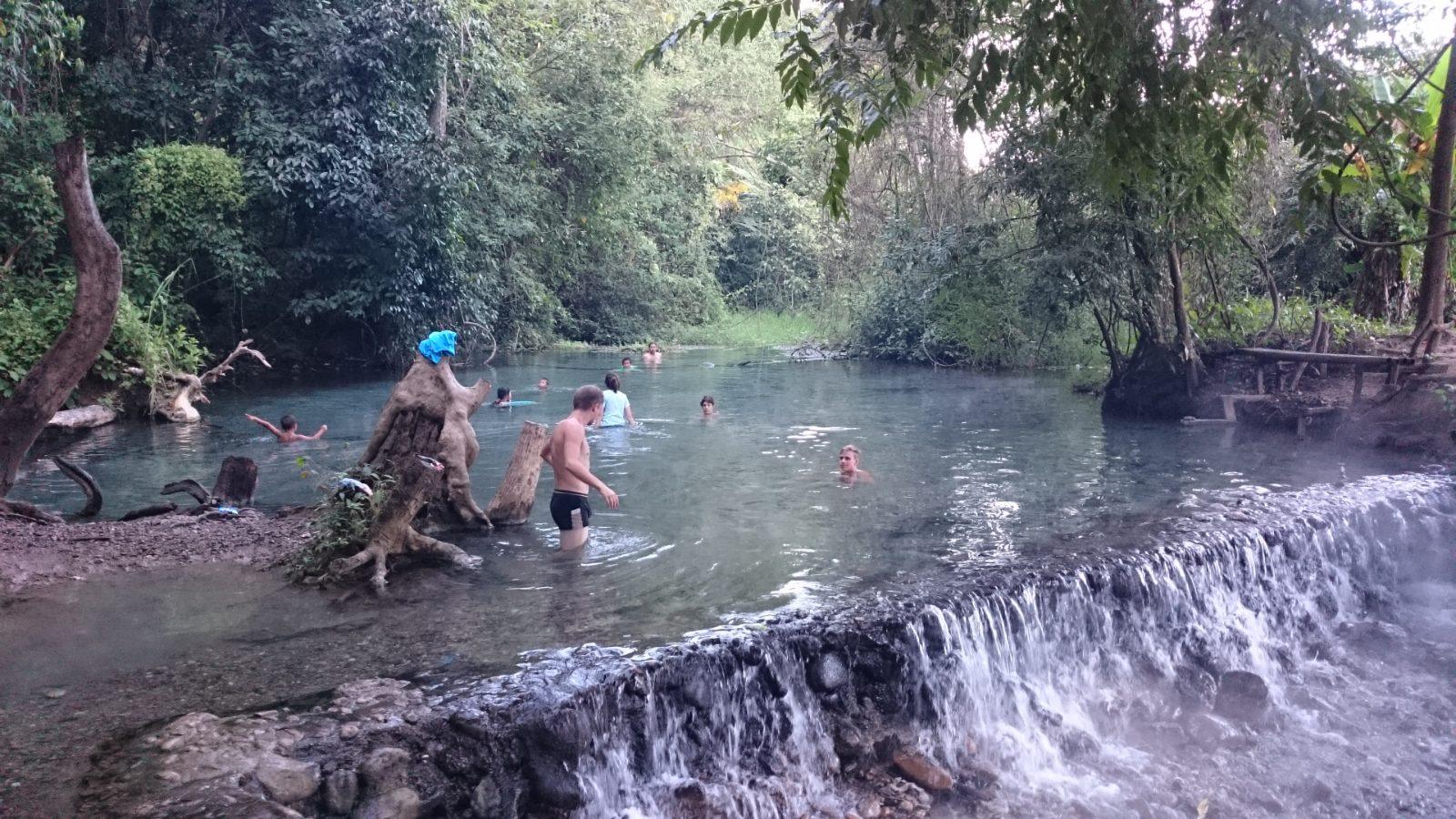
Sai Ngam Hot Spring, Pai: Sgroey / CC BY-SA 4.0
If you are staying overnight, Pai’s guesthouses and boutique stays fill up fast in high season (November–February) — browse places to stay in Pai on Agoda before you commit to the drive.
Practical things to know before you go
Pai town has numerous ATMs available, and card acceptance is reasonable in the center — the usual advice to carry a cash-and-card mix mostly applies to rural stops like the hot springs or canyon entrance, where only cash is realistic [VERIFY]. Northern Thailand’s burning season — roughly February through April, when agricultural and forest burning drives hazardous PM2.5 levels across the region — affects Pai the same way it affects Chiang Mai, since they sit in the same air basin; if you are sensitive to air quality, avoid this window or check a live AQI reading before you commit to travel dates. The sweet spot for both the destination and the drive itself is November through February: cool, dry weather, and on early departures from Chiang Mai you may catch a genuine sea of mist over the valleys along the way.
TTC Verdict: Base yourself in Chiang Mai for your Northern Thailand trip, and treat Pai as a dedicated two-to-three-night side trip rather than a rushed day tour. The winding Route 1095 drive eats the better part of a day each direction, and the travelers who rate Pai highest are almost always the ones who were not racing back to the van.
Yes, if you can give it at least two nights. Pai rewards a slower pace — sunset at the canyon, the night market, hot springs without a tour-bus schedule. A guided day trip from Chiang Mai is sold and is doable, but you will spend more of the day in the van than in Pai itself.
About three to four hours by shared minivan or private car on Highway 1095, a winding mountain road. A self-driven scooter typically takes six to eight hours including stops. No scheduled flights currently serve this route [VERIFY].
Not currently. Pai has a small airport, and a regional carrier attempted to relaunch Chiang Mai–Pai flights in 2026, but suspended the route within weeks. Plan around the road trip rather than a flight, and check current status close to your travel dates [VERIFY].